For my senior capstone project, myself and a team of six others had designed a spacecraft capable of acquiring the orbital position and velocity values for particles of space debris which pass by the spacecraft, from 0.1 cm sized particles at a distance of 5 meters from craft out to 10 cm sized particles at a distance of 500 meters away. The critical design review of the project can be illustrated in this paper.
A division of Daedalus Astronautics club participated in the CURT Maximum Altitude Competition, striving to reach 30,000 ft with a level K motor and maintaining a thrust to weight ration of 5:1. Our design consisted of a single stage, minimum diameter rocket which used a Cesaroni K300 motor. Rocksim analysis estimated reaching an altitude of 27,000 ft, breaking any record currently held within the club.
However, due to an unfortunate failure in the motor casing retainer, the motor launched up through the rocket, blowing out the top of the nose cone and destroying the rocket. This failure and project as a whole still proved to be immensely educational, showing what Daedalus is capable of achieving. Read More
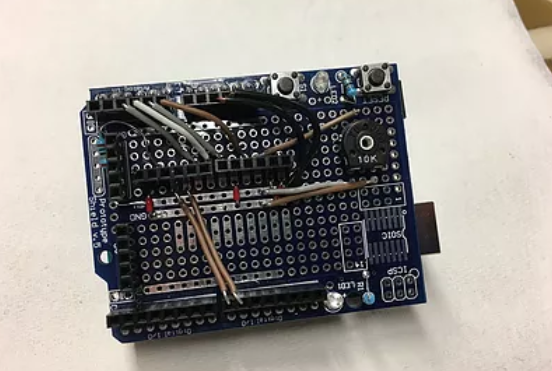
The purpose of this project was to design and build an attitude control system for a two stage rocket. This system utilized a cold gas propellant, such as nitrogen, to correct the rockets position in three dimensional space. This system was powered by an ardurino and uses an inertial measurement unit (IMU) to measure and quantify the rockets angular rate, linear velocity, and position in a global reference frame. This system consists of 8 De Laval ( converging-diverging) nozzles , four to control pitch and yaw, two to control clockwise roll, and two to control counterclockwise roll. The overarching goal of this system is to stabilize the rocket under powered and un-powered flight, assist in stage separation, and assist in landing the booster stage (first stage) using landing legs. Read More
As a freshman entering the Daedalus Astronautics club, you are divided into two separate drag race teams. Each team is required to design and build a rocket from scratch, while being able to justify the design and explain the basic components of the rocket. The overall goal of this competition is to see which rockets can reach an altitude of 6,000 ft in the shortest amount of time. As a member of this team, I learned a lot of the basic components of the rocket as well as applied my knowledge and created one in the lab. For example, we spent several weeks learning things about the center of gravity, center of pressure, thrust to weight ratios, etc. The rocket launch was a success and landed safely, even though it was a few seconds shy of winning the competition. Read More

These few personal projects are built as gifts or just as fun, educational projects I have completed. This is may way of doing more than what is expected from my class work and has taught me unique things that can't be shown in a class room environment. These projects range from laser engraving personalized gifts to coding websites and even developing a smart mirror. Read More