Leading a small team through the development of an Ethanol/LOX 100lbf thrust test stand mounted engine. The purpose of this engine is to build a strong knowledge base in the club regarding liquid propulsion and eventually assist in the development of a liquid propulsion flight vehicle.
The system will use two GN2 pressurized propellant tanks to flow into an impinging injector plate mounted to the thrust chamber on the test stand. Avionics will monitor temperatures, pressures, flow rates, and thrust data and compare it to expected results to determine which designs and predictions were done correctly and which were not. The planned burn time is 4 seconds, and multiple tests are planned. Test operations will take place at ASU's West Campus, led by myself, two other team members and a faculty advisor. Injector design, thrust chamber design, piping & instrumentation, and structural analysis are being done with various software including: Solidworks, Python, ANSYS, LabView, Excel, and RPA.
This project is in the early design and funding allocation phase, so photos and videos are soon to come. I am the team lead for the Avionics responsible for secure communication, safety/abort parameters, data acquisition, and test operations for the project.
The purpose of this project is to design and build an attitude control system for a two stage rocket. This system will utilize a cold gas propellant, such as nitrogen, to correct the rockets position in three dimensional space. This system is currently powered by an arduino and uses an inertial measurement unit (IMU) to measure and quantify the rockets angular rate,linear velocity, and position in a global reference frame. This system will consist of 8 De Laval ( converging-diverging) nozzles , four to control pitch and yaw, two to control clockwise roll, and two to control counterclockwise roll. The overarching goal of this system is to stabilize the rocket under powered and un-powered flight, assist in stage separation, and assist in landing the booster stage (first stage) using landing legs. Read more
Solid Rocket Propellant Research
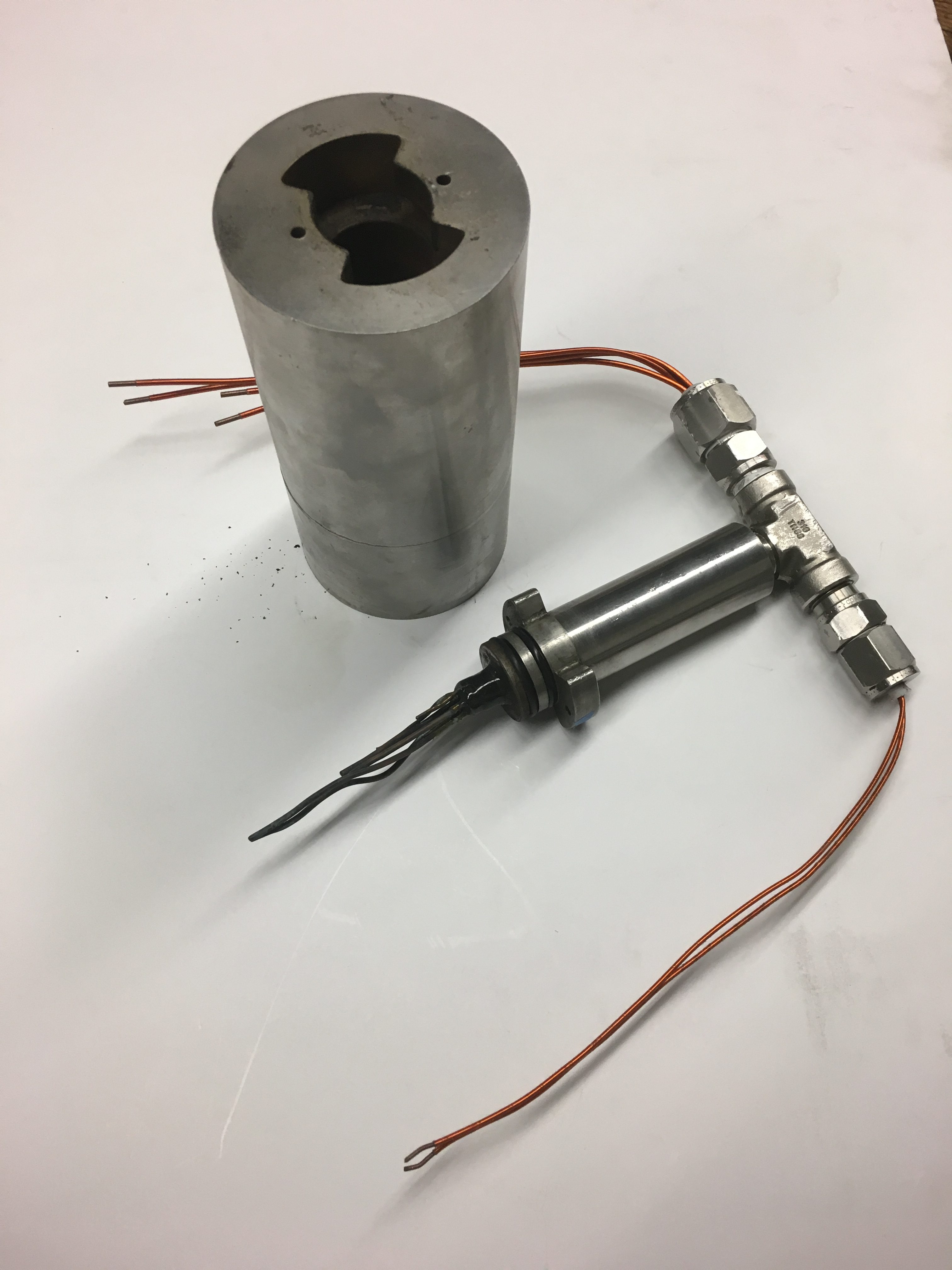
Wanting to further my understand in the way rockets operate, it is critical to understand their propulsion systems. As a result, I joined the Solid Rocket Propellant Research team within the Daedalus Astronautics team. Within this team, we have designed and mixed our own chemical compounds that make up the propellant. A few of these propellants have been characterized within the Crawford Stand Burner. Our goals for this year and to cast this propellant into small motors with out own propellant and eventually launch a rocket with a rocket motor I have designed and created.